It usually shows up around 4 p.m. That dull tightness where your neck meets your shoulders, the kind that makes you roll your head side to side at your desk. You lean back to stretch it out, and your chair stops at your shoulder blades. There's nothing there to catch your head. So you tip your skull back into empty air, hold it a second, and go back to typing.
That gap is exactly what an office chair headrest is meant to fill. But here's the honest question most product pages skip: do you actually need one, or is it a feature you'll pay for and never use? The answer isn't a clean yes. It depends on how you sit, how long you sit, and what you expect the headrest to do.
Let's get into it properly.
What a headrest actually does (and what it doesn't)
A headrest supports your cervical spine, the top stretch of your neck, but only in certain positions. When you're hunched forward over a keyboard, head down, chin tucked toward the screen, the headrest is doing nothing. Your head isn't touching it. So if you're picturing a headrest fixing your typing posture, that's not its job.
Its job is the lean-back moments. The phone call where you tip away from the desk. The thirty seconds you spend staring at the ceiling trying to remember a password. The slow scroll through a long document where you're reading, not writing. In those moments your head has real weight, roughly 5 kg, and your neck muscles either hold it up or hand it off to something. An office chair with headrest gives them somewhere to hand it off.
So the real test is simple. Do you ever recline during the day? If yes, a headrest earns its place. If you sit rigidly upright for two hours and then leave, you can probably skip it.
Who really needs an office chair headrest, and who can skip it
Some people feel the difference within a day. Some barely notice.
You'll likely benefit if you do long stretches at the desk, six, eight, ten hours, because the recline breaks add up over a day. Tall users feel it too; a chair back that ends mid-spine leaves the neck completely unsupported. If you already carry tension in your neck and upper back by evening, that's your body telling you it's been holding your head up unaided all day. Gamers lean back between rounds. Readers tilt back to think. For all of them, an ergonomic office chair with headrest is less a luxury and more the thing that makes the recline usable.
Who can skip it? If your sitting sessions are short, if you genuinely never lean back, or if you're on the shorter side and a tall backrest just gets in the way, the headrest may sit unused behind your head. No shame in that. Better to know before you spend.
But for most people doing real desk hours in India's work-from-home reality, the lean-back is constant. You just may not have noticed how often you do it.
Fixed vs adjustable: why the headrest has to move
Here's where a lot of cheap chairs fall down.
A headrest bolted into one position assumes everyone's neck sits at the same height. It doesn't. If the headrest catches one person behind the skull, it shoves the next person's head forward like they're being pushed to read fine print. A headrest in the wrong spot is worse than no headrest, because it forces your neck into a position it doesn't want. Plenty of budget chairs get this wrong, which is why a cheap office chair with headrest can feel worse than your old one.
This is the whole argument for an adjustable headrest office chair. The headrest needs to move up and down to find the base of your skull, and it should tilt to meet your head at the angle you actually recline to. Two axes, minimum. A good adjustable headrest office chair lets you set it once and forget it, because it's set to you and not to some average.
The Drogo PosturePro, for instance, has a headrest you adjust for both height and angle. Sounds small. It's the difference between a headrest that cradles your neck and one you end up ignoring.
What to look for in an office chair with headrest
A headrest doesn't work alone. It's one part of a chair, and the chair around it has to hold up. Here's what actually matters when you're comparing an office chair with headrest.
Headrest movement. Height and angle adjustment, as above. Non-negotiable.
A recline worth leaning into. The headrest only pays off when you lean back, so the recline has to feel secure. Look for a tilt-lock you can set at different angles. The PosturePro's back tilts and locks anywhere from 96 to 126 degrees, so you can park it at a slight lean for calls or a deeper one for breaks.
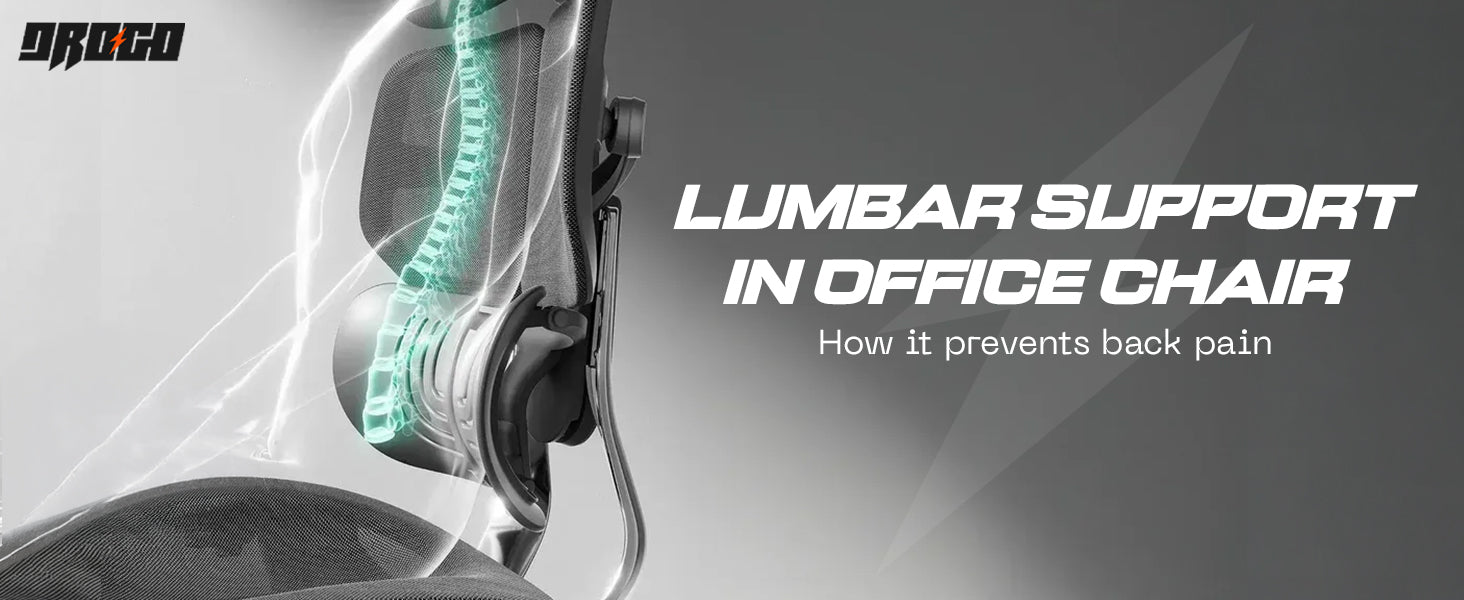
Lumbar support that pairs with it. Your lower back and your neck are two ends of the same spine. Good neck support sitting above a flat, unsupported lower back just moves the ache around. The better chairs track your lumbar curve and let you tune the firmness.
Build you can trust. This is where the rupees go. A wobbly gas lift that slowly sinks mid-call is the classic budget-chair failure. Check that the pneumatic cylinder and the caster base are tested to a real standard. Drogo's are SGS-tested. And check the weight rating; the PosturePro is built for up to 125 kg.
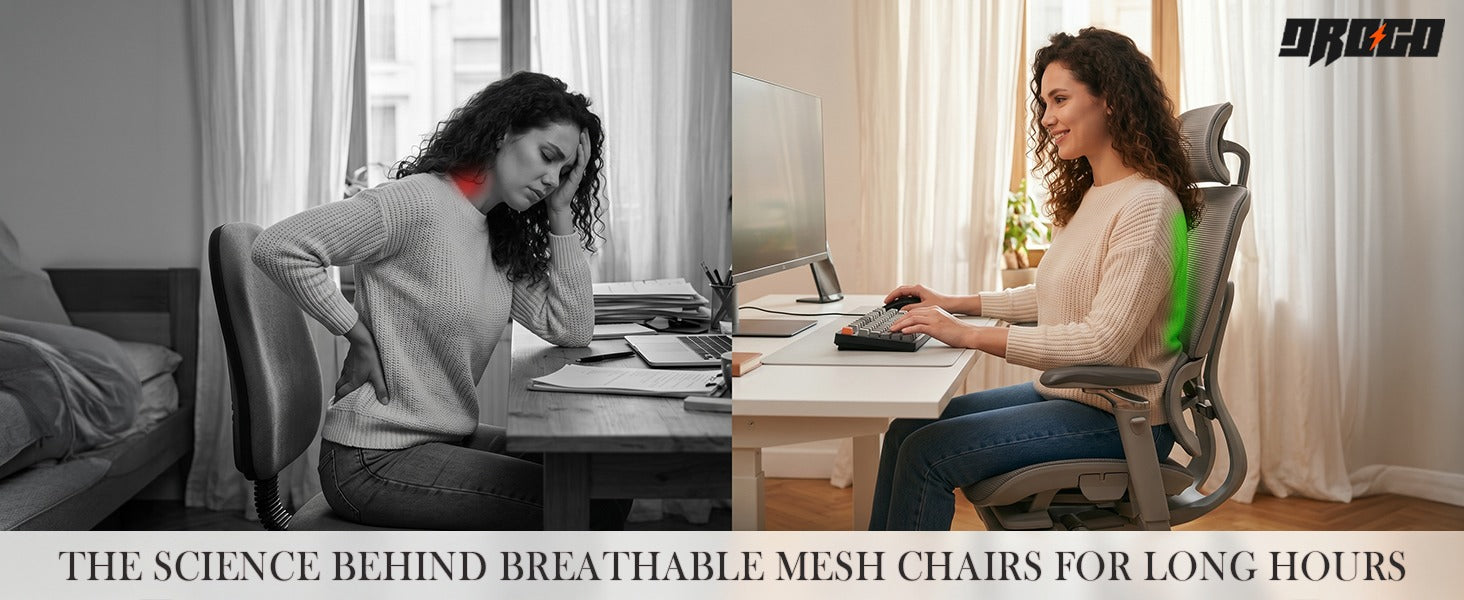
Breathability. A mesh back breathes in a way a padded one doesn't, which matters if you've ever finished a Chennai afternoon with your shirt stuck to the chair. The trade-off: cushioned foam feels a touch plusher on day one. Mesh wins by week two.
Tick those and you've got a real ergonomic office chair with headrest, not just a tall chair with a pad stapled on top. The brand that nails the headrest usually nails the rest, because getting it right means they thought about the whole sitting position.
Why a high back office chair with headrest beats a mid-back one
You can't really separate the two. A headrest has to mount on something, and that something is a tall backrest.
Mid-back chairs end around your shoulder blades. They're fine for short sits and they tuck under a desk neatly. But there's physically nowhere to put a headrest, so your neck is on its own. A high back office chair with headrest runs the support up your whole spine and then adds head support on top. When you recline, the back of your body is held from lower back to neck, instead of just the bottom two-thirds.
That's the case for a high back office chair with headrest if you do long hours: the recline is only restful when nothing's left hanging. A tall back makes the headrest mean something.
The Drogo PosturePro: a high back office chair with headrest that gets the basics right
If you've read this far, you know what to look for. The Drogo PosturePro lines up against the checklist cleanly, which is why it's worth a look as a high back office chair with headrest for daily work.
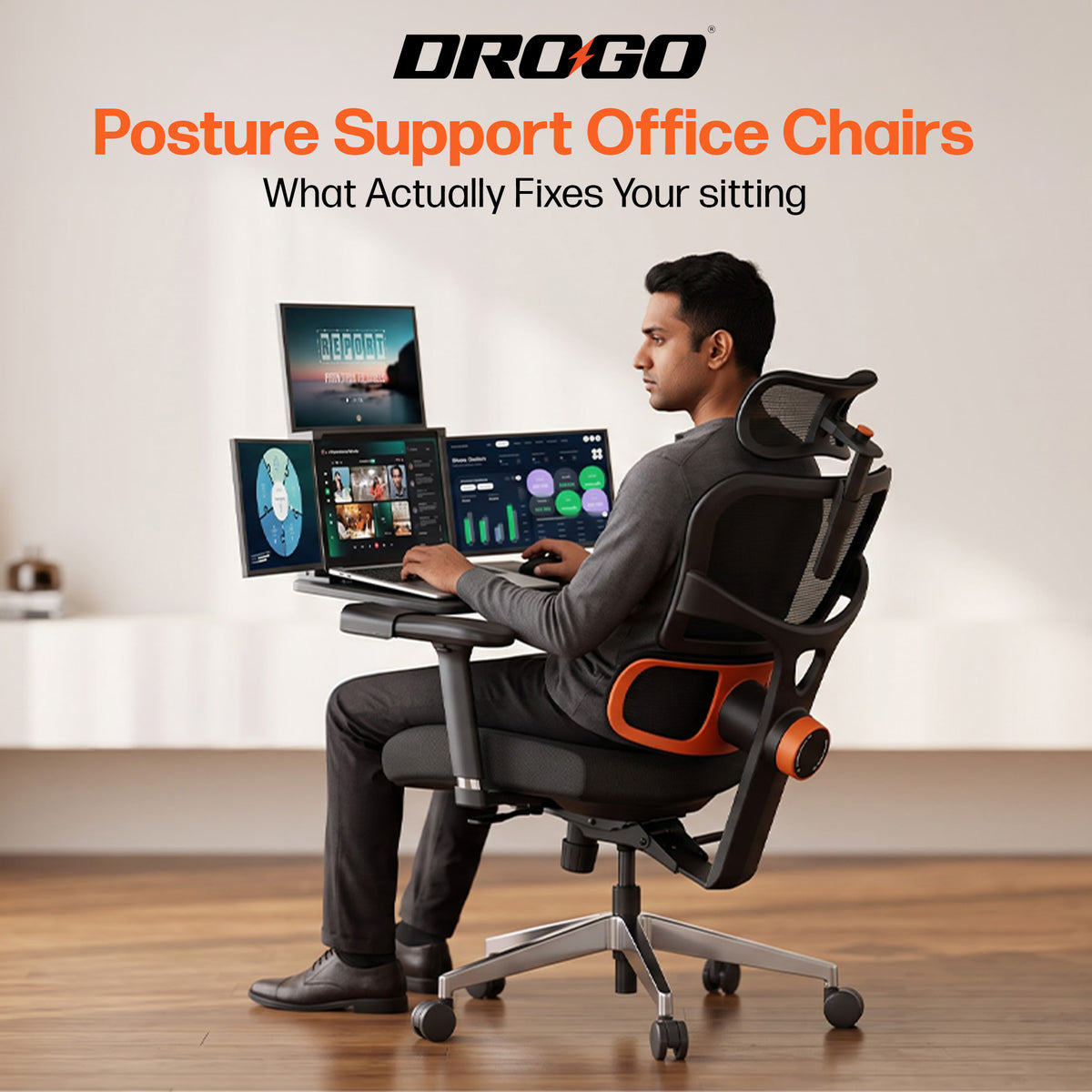
Start with the headrest, since that's why you're here. It adjusts for height and angle, so you can set it to the base of your skull and to your own recline. The backrest is breathable mesh with three height options and a tilt-lock that runs 96 to 126 degrees. The lumbar support is adaptive; it follows your lower back rather than sitting as a fixed bump, and you can dial the strength. Under you is a high-density memory foam seat that slides forward and back and raises and lowers, plus 4D armrests that move four ways.
The parts you don't see decide whether a chair lasts. The gas lift and caster wheels are SGS-tested, the base swivels a full 360 degrees, and it's rated to 125 kg. Drogo backs it with a 3-year warranty, longer than a lot of chairs in its bracket, which tells you something about how they expect it to hold up. It runs around ₹22,990 at the time of writing, in black or grey.
Is it perfect? No chair is. The mesh seat is firmer than a thickly padded one, so if you want sink-in cushioning from minute one, that's fair to weigh. And it ships flat in a box, so you'll spend twenty minutes with a hex key on a Sunday. Neither is a dealbreaker for a chair you'll sit in for years. As an ergonomic office chair with headrest in this price range, it's a genuinely solid buy.
Getting the headrest dialled in
A headrest set wrong is a headrest wasted, and most people never adjust theirs out of the box. Takes about thirty seconds to fix.
Sit all the way back first. Set your lumbar support so it meets the curve of your lower spine. Then raise or lower the headrest until it sits at the base of your skull, not high on the back of your head and not down on your neck. Tilt it so it touches your head when you lean back to your usual angle, not when you're bolt upright. Then set your tilt-lock. You'll hear it click into place.
That's it. On a properly adjustable headrest office chair the whole thing takes one sitting and then disappears into the background, which is what good support should do. You stop thinking about your neck. Done right, an office chair headrest isn't something you notice. It's something you stop noticing, because the ache that used to arrive at 4 p.m. just doesn't.
Frequently Asked Questions
Do I really need an office chair headrest, or is it just a gimmick?
It's genuinely useful if you ever recline during the day, and pointless if you don't. The headrest supports your neck in the lean-back moments, calls, reading, thinking, breaks, not while you're typing upright. If you do long hours and tip back often, an office chair with headrest takes real load off your neck. If you sit rigidly for short stretches, you won't miss it.
What's the difference between a fixed and an adjustable headrest office chair?
A fixed headrest stays in one spot, which only fits you if your height happens to match where the maker put it. An adjustable headrest office chair lets you move it for height and angle, so it actually meets the base of your skull instead of pushing your head forward. For anything beyond occasional use, adjustable is the one to get.
Is a headrest useful if I sit upright all day?
Less than you'd think. When you're forward over the keyboard, your head isn't touching the headrest at all. Its value shows up the moment you lean back. If you've trained yourself to never recline, the headrest will mostly go unused, though most people lean back far more often than they realise.
Does a headrest help with neck pain?
It can help with the neck fatigue that builds from holding your head up unsupported for hours, especially during recline. It isn't a medical fix, and posture, screen height, and regular breaks all matter too. Paired with good lumbar support, an ergonomic office chair with headrest reduces the strain that often turns into evening stiffness. If you have ongoing pain, see a professional.
How much weight can the Drogo PosturePro hold?
Up to 125 kg. Its gas lift and caster wheels are SGS-tested and the base is built for daily heavy-duty use, so the rating holds up in practice rather than just on paper.
Is the PosturePro hard to assemble, and what's the warranty?
It ships flat and self-assembles with the included hex key in about twenty minutes: backrest, seat, base, wheels. Drogo covers it with a 3-year warranty against manufacturing defects; register it on their site after delivery. As a high back office chair with headrest in its price range, that warranty length is on the generous side.
If your neck's been quietly complaining through your workday, a headrest is one of the cheaper fixes that actually changes how the day feels. Just make sure it moves to fit you. The Drogo PosturePro is a sensible place to start if you want one that does.
Follow Drogo on Instagram and Facebook for setup tips, new launches, and real desk setups.